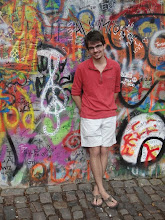
What follows is my final essay for my english composition class. Let me know what you think...
The hall lights dim as the conductor steps onto the podium, and the audience grows quiet. The orchestra, choir, and soloists watch him, waiting for his signal to begin. I sit in the back row of the auditorium, and the tiniest seed of envy begins to grow in me… I should be up there, standing fourteen people from the left in the second row of that choir.
Te decet hymnus Deus, in Sion… Near the end of his life, Wolfgang Amadeus Mozart took a commission from Count Franz von Walsegg. Walsegg wanted a requiem mass to be written in commemoration of his recently deceased wife, which he then intended to pass off as his own work before his friends. Mozart died before he completed the piece, and his wife secretly passed the work off to Franz Süssmayr, one of his students, to complete. Disputes about the authorship of the Requiem arose shortly after its premiere, and legends began to accumulate: the angel of death had commissioned the requiem for the composer’s own death; jealous rivals poisoned him to prevent the completion of the work; and so forth. The legends were so pervasive, that Alexander Pushkin wrote a play about Mozart’s life in which he incorporated these legends. The play was so popular that Rimsky-Korsokov converted it into an opera, which was in turn so successful that Peter Shaffer wrote an additional play, which was then turned into the very popular 1984 film Amadeus. There is still debate to this day about how much of the Requiem was written in Mozart’s own hand, and how much was composed by Süssmayr; whether or not Mozart left instructions for the completion of the requiem; etc.
Libera me, Domine, de morte aeterna, in die illa tremenda… My name is Robert Scott Sparks, and I am no stranger to death. My first encounter with him occurred when I was only four years old, when my mother died of breast cancer. Being young, I didn’t quite understand the concept of death, so I never really grieved for my mother; by the time I was old enough to understand and feel grief, her death was something I had grown up with: sad, but not the end of the world. Since then, I have lost two uncles, two grandfathers, and several friends. I have not become numb to loss, but I have accepted it as a normal part of life, and do my best to smile through the pain, for others and for myself… I have always felt the need to help the ones I care about, and providing that strength when they feel vulnerable brings me a joy that outshines the pain.
Absolve, Domine, animas omnium fidelium defunctorum… I am nineteen years old, and for as long as I can remember, I have been a musician. As a small child I would sing in my sleep, and I had a toy keyboard that I played with until it broke. I began taking piano lessons when I was in 2nd grade, I played in band all through middle and high school, and sang tenor in choir all through high school. There was no question in my mind that when I went to college, I would major in music. When I started college, the one class I looked forward to more than any other was choir. You have to understand that in high school, the choir room was my home away from home: Mrs. Snow, my choir director, was like a second mother to me. Since I’d gone so far away from home to go to college, I was looking for that same familial atmosphere that I’d come to associate with choir.
Hostias et preces tibi, domine, laudis offerimus… In that first class, Dr. Lucas announced that we’d be singing the Mozart Requiem this semester. Upon this revelation, the choir perked up. I was particularly excited, because I’d never sung a large-scale choral work before, and I’d wanted to for some time. As the semester continued, though, I found myself doubting whether or not I’d chosen the right profession: there were so many students in the School of Music who were so talented, and although I was grateful to count them as friends, I began to wonder how I could begin to think I could compete with them… after all, there is the stereotype of the “starving artist,” and since I had o desire to teach, that eliminated the majority of job positions for me in the industry. I shoved my doubts aside, but they remained in the back of my mind, making me doubt myself.
Domine, Jesu Christe, Rex gloriae libera animas de poenis inferni… After much preparation and anticipation, the week of the concert arrived. Monday night we had our first rehearsal with the combined choirs, under the baton of Dr. Richard Zielinski. From seven to ten we rehearsed that night. For three hours, we agonized over the tiniest details of this monumental work of music, this last attempt by that man on his deathbed to capture the sound of heaven in a mortal realm. As Zielinski urged us to consider the text of the piece, and to relate it to our own lives, I couldn’t help but think of those I had lost, particularly my mother. As we moved to the Sequentia, The fierce determination and agonizing pain that Mozart must have felt as he scratched out the vocal lines from his bed, assisted by his wife and student, came through to us. The sobbing texture of the Lacrymosa, the last piece of music that Mozart completed before his death, nearly pushed me over, and I struggled to keep my voice steady. By the time we got to the Agnus Dei, I was exhausted. As Zielinski talked us through his emotional understanding of the movement, I sat there, my head drooping to my knees. Our accompanist was playing the piano reduction underneath Zielinski’s commentary, and then they both paused on a chord that, according to Zielinski, was a question those in mourning: a question of how you would learn from the death of those who have passed. The question resonated with my self-doubt: is this what I should do with my life? Was I really intended to be a musician, or was it a passing fancy gone too far? Would I wake up one morning and realize that I hate my job, like so many people do? Was I even good enough to get a job?
Quantus tremor est futurus, quando judex est venturus, cuncta stricte discusurus… I slept heavily that night, hoping that morning light would bring fresh perspective. The next morning, however, I felt like death. I spent the next four days shivering under my sweat-drenched covers. I was unable to eat, because as I gulped water, trying to stay hydrated, tiny, vicious, glass-shard kittens dug claws into my esophagus, protesting against the disturbance.I didn’t attend a single rehearsal from Tuesday to Friday of that week. On Friday, I went to the doctor, and after a few tests they led me to an operating room. I sat there, terrified, as the needle-wielding doctor told me to open my mouth so they could drain my throat. It didn’t hurt terribly, but the entire time I was terrified that the doctor was going to slip somehow, and that I’d never be able to sing again. I’d given up on singing in the Requiem after I missed the rehearsal on Tuesday, but the thought of giving up on choir entirely was too much for me to bear.
Dies irae! Dies illa solvet saeclum in favilla: teste David cum Sybilla… On performance day, I sat in the back of the auditorium. The conductor stood on his podium, and as he raised his arms, the energy radiating from the ensemble electrified the silence that hung on the ictus of his baton, a drop of water waiting to be dislodged by the lightest flick.
Tuba, mirum spargens sonum per sepulchral regionum, coget omnes ante thronum… With his downbeat, the strings began to pulse restlessly: a slow heartbeat of grief that drives a wailing bassoon/clarinet melody that foreshadows the violent anger of the brass fanfare, demanding to know why the deceased has been torn from those who loved her. The choir begs for rest not just for the dead, but also for the living who grieve. As the music drapes itself over the hall, velvety textures caressing those in attendance, comforting their losses past and present, my envy died. Tears streamed down my face, and I began to understand that this is absolutely what I had to do with my life. I could see the audience around me, moved by music that, although written over two centuries ago, still spoke volumes today. I knew then, that I had chosen the correct profession. Even if I didn’t have the biggest house, the flashiest car, or the nicest clothes later in life, I knew that I wanted to make people feel things outside of their day-to-day lives.
Benedictus qui venit in nomine Domini… I left that performance feeling as if I had just taken a very refreshing shower. I realize that such a sentiment is an unusual feeling coming from a performance of a requiem mass, but being reaffirmed in your decision is a good feeling. It’s not every day you get slapped in the face by a voice saying, “Look. That’s what you’re supposed to be doing with your life,” so perhaps getting poked in the throat with needles had an extra-medicinal benefit. Next semester, we’re singing Mendelssohn’s Elijah. I hope that I can change someone in that audience the way that I was changed that day.
Lux aeterna luceat eis, Domine, cum sanctis tuis in aeternum, quia pius es. Amen.


 Posts
Posts